Main business models of China's industrial valve industry
The mainstream business models in the industrial valve industry can be divided into two types: the order based business model that determines production based on sales, and the stocking based business model that arranges production in advance. The order based business model emphasizes that enterprises arrange production after receiving orders, and valve enterprises usually need to customize production according to the order requirements of the engineering project party. Large industrial valve enterprises usually have strong competitive strength, so the order based business model is often used for large-scale engineering project construction. The stocking business model refers to a model in which an enterprise arranges production plans in advance and then sells them. This model is suitable for standardized and high demand general valve products, usually used to meet the daily maintenance and upkeep needs of engineering facilities. Distributors purchase from industrial valve enterprises and then sell to end customers.
The sales models of industrial valve enterprises mainly include three types: direct sales, distribution, and agency (see Figure 2-3):
Figure 2-3 Sales Model of China's Industrial Valve Industry
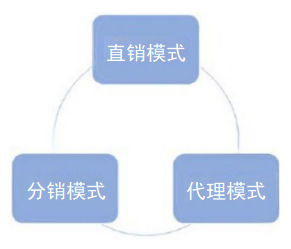
direct selling model
This model refers to industrial valve enterprises directly selling their products to end customers or engineering contractors, and is often used in areas where industrial valve enterprises have obvious advantages and strong product competitiveness. Key customers of some industrial valve enterprises or benchmark enterprises in downstream industries usually have a high demand for industrial valve products, high requirements for technical services, and strict requirements for price and payment. These customers usually choose to purchase directly from the enterprise. In addition, adopting a direct sales model is conducive to establishing direct contact between enterprises and customers, facilitating maintenance and communication with customers.
Distribution Model
This model is aimed at regional (especially remote areas) non mainstream markets with low sales volume, mainly targeting domestic ordinary customers and foreign customers. For standardized valve products, some industrial valve companies adopt a distribution sales approach, establishing a sales organizational structure that combines channel management and regional sales. The advantage of this is that it can meet customer needs in the first place.
Proxy Pattern
Industrial valve enterprises usually use the agency model in areas where their advantages are not obvious and their product competitiveness is not strong. In this mode, enterprises usually choose distributors with good reputation and extensive sales channels to become valve brand agents, further expanding sales channels and increasing product sales volume.
In recent years, in order to promote the healthy development of the industry, there has been an increasing demand from industrial valve enterprises for innovative business models. Driven by the current trend of the sharing economy, the industrial valve industry has given birth to an innovative business model - the sharing model. The sharing mode refers to the joint construction of a sharing, communication, and cooperation platform by valve manufacturers, distributors, purchasers, and engineering companies. The role of this platform is to strengthen information communication and sharing between producers, intermediaries, and demanders, reduce vicious competition in the industry, achieve mutual benefit and win-win results, and ultimately promote the healthy and stable development of the valve market.