Your location:

/ News / Company news

KAI WEI XI
  • Company news

  • Industry news

  • Current political news

Contact Us
  • Phone:+86 (577)6730 7899
  • Mobile:+86 150 6844 4310
  • Fax:+86(577)6738 7099
  • Email:sales@kaiweixi.com
  • Address:No.1 Linxia Road, Oubei Street, Yongjia County, Zhejiang Province, China
  • Website:https://www.kaiweixi.com
  • Industrial chain of China's industrial valve industry

    Industrial chain of China's industrial valve industry

    The industrial valve industry chain in China can be divided from top to bottom into upstream raw material suppliers, midstream industrial valve enterprises, and downstream sales customers (see Figure 2-4)

    Figure 2-4 China Industrial Valve Industry Chain

    The upstream of the industrial valve industry mainly consists of industrial raw material suppliers such as sheet metal, pipe fittings, castings, forgings, and control components. Castings are the core components in the production process of industrial valves, and the production of steel has a direct impact on the price of castings. In recent years, China's steel industry has developed rapidly. According to data from the Stainless Steel Branch of the China Special Steel Enterprise Association, the crude steel production of stainless steel in China reached 25.774 million tons in 2017, an increase of 1.165 million tons year-on-year, or 4.7%. This can provide sufficient and stable raw materials for valve production. Due to the low entry threshold and large number of participants in the upstream industry, the market development is relatively mature, and the product supply is sufficient, resulting in low bargaining power.

    The midstream of the industrial valve industry consists of industrial valve enterprises, mainly responsible for the production and sales of industrial valve products. There are numerous enterprises in the industry, fierce price competition, overcapacity in low-end products, and insufficient production capacity and supply of high-end products. According to Sullivan data, raw material costs account for about 70% of valve production costs. The sales price of valve products is usually based on product costs and adjusted according to gross profit margins and changes in raw material prices. If raw material prices rise significantly in the short term, industrial valve companies may not be able to offset or transfer the impact of rising raw material prices on product costs by increasing sales prices. In order to strengthen cost control and better control product quality, leading enterprises in the industry have a strong willingness to penetrate upstream, strong ability to integrate upstream and downstream resources, and can achieve the full coverage of the complete industrial chain from research and development design to raw material production and processing, meeting the requirements of cost reduction, shortened delivery time, and customer review. For example, Neway Corporation has established two valve casting production supporting enterprises, which can produce various carbon steel, stainless steel, and alloy steel castings. This not only provides a stable source of castings for Neway's valve products, but also sets higher quality requirements to meet the needs of high-end customers. Due to the fact that most industrial valve enterprises are engaged in the production and sales of low-end valve products, and the homogenization competition in the low-end valve market is fierce, their bargaining power in downstream industries is generally not high; In the high-end valve market with extremely high product technology content and few competitors, international valve giants and some leading Chinese industrial valve enterprises have strong bargaining power for special valve products such as nuclear power valves.

    The downstream industries of the industrial valve industry mainly include oil and gas, electricity, metallurgy, water, chemical and other fields. The fields of oil and gas extraction and transportation, electricity, and chemical applications are the largest areas of industrial valve applications in China, accounting for about 70% of downstream applications (see Figure 2-5). The downstream industry's fixed assets investment and cyclical fluctuations have a greater impact on the demand for valves in the midstream. Since the global economy recovered in 2010, the downstream industry's prosperity has improved and industrial construction has intensified, driving the demand for valve products, further expanding the size of the valve market, giving downstream enterprises in the industrial chain a strong bargaining power.

    Figure 2-5 Downstream Application Proportion of Industrial Valves in China in 2017

    12-11

    2025

  • Main business models of China's industrial valve industry

    Main business models of China's industrial valve industry

    The mainstream business models in the industrial valve industry can be divided into two types: the order based business model that determines production based on sales, and the stocking based business model that arranges production in advance. The order based business model emphasizes that enterprises arrange production after receiving orders, and valve enterprises usually need to customize production according to the order requirements of the engineering project party. Large industrial valve enterprises usually have strong competitive strength, so the order based business model is often used for large-scale engineering project construction. The stocking business model refers to a model in which an enterprise arranges production plans in advance and then sells them. This model is suitable for standardized and high demand general valve products, usually used to meet the daily maintenance and upkeep needs of engineering facilities. Distributors purchase from industrial valve enterprises and then sell to end customers.

    The sales models of industrial valve enterprises mainly include three types: direct sales, distribution, and agency (see Figure 2-3):

    Figure 2-3 Sales Model of China's Industrial Valve Industry

    direct selling model

    This model refers to industrial valve enterprises directly selling their products to end customers or engineering contractors, and is often used in areas where industrial valve enterprises have obvious advantages and strong product competitiveness. Key customers of some industrial valve enterprises or benchmark enterprises in downstream industries usually have a high demand for industrial valve products, high requirements for technical services, and strict requirements for price and payment. These customers usually choose to purchase directly from the enterprise. In addition, adopting a direct sales model is conducive to establishing direct contact between enterprises and customers, facilitating maintenance and communication with customers.  


    Distribution Model

    This model is aimed at regional (especially remote areas) non mainstream markets with low sales volume, mainly targeting domestic ordinary customers and foreign customers. For standardized valve products, some industrial valve companies adopt a distribution sales approach, establishing a sales organizational structure that combines channel management and regional sales. The advantage of this is that it can meet customer needs in the first place.  


    Proxy Pattern

    Industrial valve enterprises usually use the agency model in areas where their advantages are not obvious and their product competitiveness is not strong. In this mode, enterprises usually choose distributors with good reputation and extensive sales channels to become valve brand agents, further expanding sales channels and increasing product sales volume.  


    In recent years, in order to promote the healthy development of the industry, there has been an increasing demand from industrial valve enterprises for innovative business models. Driven by the current trend of the sharing economy, the industrial valve industry has given birth to an innovative business model - the sharing model. The sharing mode refers to the joint construction of a sharing, communication, and cooperation platform by valve manufacturers, distributors, purchasers, and engineering companies. The role of this platform is to strengthen information communication and sharing between producers, intermediaries, and demanders, reduce vicious competition in the industry, achieve mutual benefit and win-win results, and ultimately promote the healthy and stable development of the valve market.

    11-11

    2025

  • Development status of China's industrial valve industry

    Development Status of China's Industrial Valve Industry


    Overall, benefiting from industrial development, urban construction, and global economic integration, China's industrial valve industry has experienced rapid growth. During this process, some long-term accumulated drawbacks within the industry have gradually become apparent: ① The industry is highly competitive and has low concentration. The competition in the Chinese valve market is fierce, but there is a lack of large-scale and world-class industrial valve enterprises, so the competition in the industry is mostly concentrated in the low-end product field. In addition, international valve giants have successively invested in building factories in China, further intensifying the competition in the Chinese industrial valve market; ② The research and development capabilities for mid to high end products are relatively weak. Similar to other traditional manufacturing industries, the low-end production capacity of the industrial valve industry is severely overcapacity, while the supply of mid to high end products is in short supply.


    The overall R&D capability of China's domestic industry in mid to high end products is weak, mainly through the introduction of foreign production processes and processing equipment, imitating the appearance design of similar foreign products to produce products, and lacking independent innovation ability. These problems cannot be fundamentally improved in the short term, which greatly restricts the healthy development of the industrial valve industry. In addition, the Chinese industrial valve industry is also facing five major task pressures: reducing production capacity, reducing inventory, deleveraging, lowering costs, and filling gaps. To complete the task, the industry is currently increasing efforts to remove low-end production capacity, insisting on independent research and development of high-end products, and promoting the development of valve technology to a higher level. Leading enterprises in the industry are integrating high-quality resources through mergers and acquisitions, and moving towards world-class industrial valve enterprises. Under the exemplary role of leading enterprises, the industry as a whole is transitioning from production-oriented manufacturing to service-oriented manufacturing, gradually shifting from the low-end market to the mid to high end market.

    11-10

    2025

  • Development history of China's industrial valve industry

    Development history of China's industrial valve industry

    The industrial valve industry in China started relatively late, with over five decades of development since its inception in the 1950s. It has roughly gone through four stages of development (see Figure 2-2):

    Figure 2-2 Development history of industrial valves in China
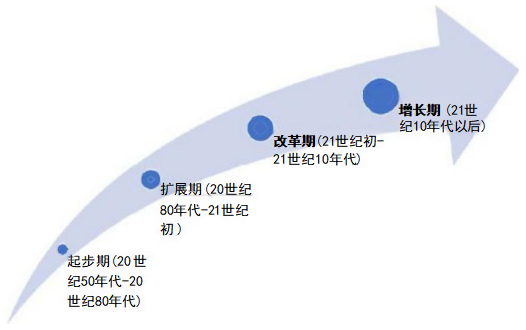
    Initial stage (1950s-1980s): In the early 1950s, some mechanical equipment manufacturing factories established by local industrial bureaus under the government began producing industrial valves for urban construction. By the 1960s, due to the needs of national defense construction, the local state-owned Suzhou Iron Factory was renamed "State-owned Factory No. 526", becoming the only nuclear professional valve production base in China. During this period, it provided approximately 420,000 high-quality valves for the first phase of nuclear industry construction and the third-front project, making a great contribution to the construction of China's nuclear industry. During this period, the types and specifications of valve products were relatively limited, mainly because valve manufacturing enterprises at that time lacked the ability to produce high-parameter and high-tech valves.  


    Expansion period (1980s to early 21st century): After entering the 1980s, China's reform and opening-up continued to deepen, and the industrial system began to learn from international advanced development experience. China's military industrial enterprises gradually realized the transformation from military to civilian, and military valve enterprises also began to independently develop and manufacture complete sets of valve products that meet international standard systems. In order to meet the growing demand for industrial valves in industrial and agricultural construction, some key valve enterprises began to adopt a combination of independent development and the introduction of foreign advanced technology to improve valve technology. Through this approach, China's valve manufacturing level and product quality have been significantly improved compared to before. Since the 1990s, China's domestically produced valve products have begun to enter international markets such as Europe, America, Southeast Asia, and the Middle East.


    Reform period (early 21st century to 2010s): Since the early 1990s, China's industrial valve industry has accelerated the pace of modern enterprise management. For example, Suzhou Valve Factory, through resource integration, was listed on the Shenzhen Stock Exchange in 1997, becoming the first listed company in China's industrial valve industry. Subsequently, the company name was changed to "CNNC Sufa Technology Industry Co., Ltd." During this period, China's valve market steadily grew, and valve technology in the petrochemical industry had become relatively mature. Industrial valve enterprises in the industry continuously intensified efforts to develop new markets and new products, laying a solid foundation for the take-off of China's technology industry. In 2008, the US financial crisis erupted, leading to a global economic downturn. This had a negative impact on fixed assets investment in industries such as oil and gas, electricity, and chemical engineering, causing a continuous decline in demand for valves and stagnating market development.  


    Growth period (after the 2010s): After 2010, the global economy gradually achieved recovery growth, and China's industrial valve industry began to recover, showing a steady upward trend. The number of industrial valve enterprises increased significantly, and a number of enterprises with high-end valve production technology gradually enhanced their competitiveness in the international market. However, overall, the market concentration of the valve industry is low, with a large number of small and medium-sized enterprises, leading to a chaotic market, which poses great difficulties for achieving standardized management in the industry.

    11-10

    2025

  • Definition and classification of China's industrial valve industry

    Definition and classification of China's industrial valve industry

    A valve is a type of equipment used to regulate, control, and direct the flow of media such as liquids, gases, and fluidized solids. It possesses functions such as stopping, regulating, directing, preventing backflow, stabilizing pressure, diverting, or relieving pressure through overflow. Industrial valves are widely used in fields such as oil and gas, electricity, metallurgy, water affairs, and chemical engineering, and are an important component of industrial equipment. There are numerous types of industrial valves, which can be classified according to their different purposes, engineering pressures, medium temperatures, valve materials, and driving methods. Based on their principles and functions, industrial valves can be divided into block valves, check valves, safety valves, regulating valves, and diverter valves according to their purposes; vacuum valves, low-pressure valves, medium-pressure valves, high-pressure valves, and ultra-high-pressure valves according to engineering pressures; ultra-low-temperature valves, low-temperature valves, room-temperature valves, medium-temperature valves, and high-temperature valves according to medium temperatures; metal material valves, non-metal material valves, and metal valve body lined valves according to valve body materials; and automatic valves, power-driven valves, and manual valves according to driving methods (see Figure 2-1).

    Classification of industrial valves

      Classification Criteria        Category                   Description

    11-10

    2025