The GWDRY Series Pilot Operated Piston High-Temperature Solenoid Valve (with nominal sizes spanning from DN15 to DN50) is a premium, heavy-duty automatic control valve engineered for modern industrial thermal networks, high-temperature gas transmission lines, complex liquid circulation loops, and high-severity thermal oil (heat transfer fluid) automation networks. Serving as a crucial isolation component within automated fluid loops, this series features advanced structural optimization designed to solve common industry issues such as carbon choking, mechanical jamming, and thermal deformation leaks. This series offers both threaded and flanged connection profiles, with models featuring suffixes "F" and "JF" custom-tailored for medium-to-high pressure industrial flanged pipelines.
The GWDRY series operates as a Normally Closed (NC) valve utilizing a fluid-assisted pilot-operated mechanism.
When the electromagnetic coil is de-energized, the internal plunger is forced downward by the return spring, completely sealing the central pilot orifice located at the geometric center of the main piston. Consequently, the upstream process fluid flows from the inlet side into the upper piston cavity via a specialized balancing throttling port. Because the pilot orifice is sealed, fluid pressure rapidly builds within the upper chamber until it reaches static equilibrium with the inlet line pressure. Leveraging the design geometry where the upper surface area of the piston is larger than the lower surface area, a downward net pressure differential is established. This high net fluid force, combined with the mechanical pre-load of the main return spring, presses the piston assembly firmly against the body seat, ensuring a zero-leakage tight shutoff.
When the electromagnetic coil receives an electrical current, it generates a high-density magnetic field. The resulting electromagnetic force overcomes the combination of internal spring resistance and plunger weight, pulling the plunger upward to open the central pilot orifice instantly. Because the cross-sectional flow area of the pilot orifice is significantly larger than that of the lateral balancing throttling port, the high-pressure fluid trapped in the upper piston chamber evacuates rapidly toward the low-pressure downstream side of the valve. This creates an immediate drop in upper chamber pressure. Consequently, the upstream process fluid pressure acting on the lower surface of the piston overcomes the residual upper chamber pressure, creating a strong upward net thrust. This force compresses the main spring and lifts the heavy piston assembly smoothly along the guided walls of the valve cavity, opening the valve completely. When the power is disconnected, the upper chamber pressure re-establishes within milliseconds, driving the piston down to complete the isolation cycle.
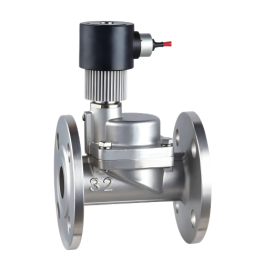
Product Image:GWDRY Piston Type High-Temperature Solenoid Valve